Broadcast Remediation Hub: mediamtx.yml, FFmpeg ABR & Sysctl
Eight production-tested remediation playbooks covering hardened mediamtx.yml, 1080p+720p+480p FFmpeg ABR ladders, /dev/shm tmpfs segment rings, and 10 Gbps kernel tuning.
8 Production Fix Guides
Hardened mediamtx.yml
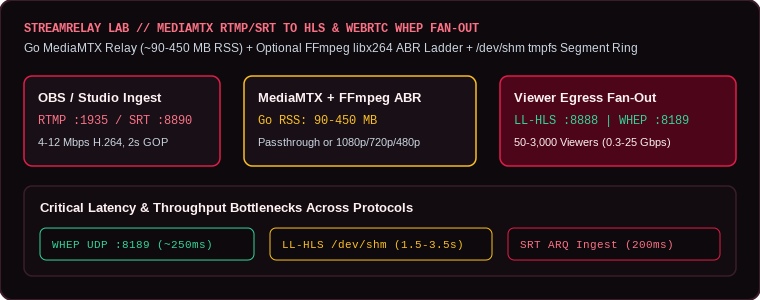
A single tuned mediamtx.yml turns a Go binary using 90-450 MB RSS into a multi-protocol relay serving OBS RTMP/SRT ingest simultaneously over LL-HLS and WebRTC.
FFmpeg 3-Rung ABR Ladder
When viewers on mobile connections buffer on a 10 Mbps source stream, a 3-rung FFmpeg ABR ladder lets players drop seamlessly to 720p or 480p without stalling.
/dev/shm tmpfs HLS Ring
Keeping your 7-second live HLS segment buffer in kernel RAM eliminates 432,000+ daily disk writes and guarantees sub-millisecond .m4s reads at 3,000 viewers.
WHEP UDP 8189 & UFW
Separating HTTPS WHEP signaling (port 443 -> 8889) from direct UDP media multiplexing (port 8189) unlocks reliable 250ms WebRTC playback across browsers.
Linux sysctl BBR & 10G
Default Linux kernel TCP cubic settings and 212 KB UDP receive buffers throttle long-distance HLS players and drop SRT/WebRTC packets under 2-8 Gbps fan-out.
SRT Passphrase & Latency
Replace plaintext RTMP ingest over public Wi-Fi or cellular uplinks with AES-encrypted SRT on UDP :8890 that survives 2-5% packet loss.
Systemd ulimit & Service
Running MediaMTX via a hardened systemd unit guarantees clean /dev/shm directory creation, 1M+ open socket capacity, and instant restarts without Docker NAT overhead.
Caddy/Nginx HLS Proxy
Web players (hls.js, Video.js, Shaka) fail silently on cross-origin manifests unless your reverse proxy strips stale .m3u8 caches and sets clean CORS headers.